

From Buzz to Business: How Airbus, Bugatti & Adidas Use AM in 2026
- Authentise Team
- Jul 24, 2025
- 3 min read
Updated: Apr 20
Back in 2019, we asked: Is additive manufacturing (AM) really ready for production? In our article “AM for Production Is Already Here,” we highlighted how big names were beginning to shift from prototyping to making real parts at scale.
Now, in 2025, let’s revisit that promise. Are these pioneers still on the AM path? Have others joined them? And what role does digital workflow play in making AM truly scalable?
✈️ Airbus: Slow but Steady Lift-Off
In 2023, Airbus was 3D printing over 1,000 components per A350 - mostly brackets and cabin parts. Today, that number is even higher, thanks to greater confidence in material qualification and growing regulatory acceptance.
What’s changed?
More parts are structural. Brackets and hinges are giving way to lightweight load-bearing elements.
Focus on traceability. Airbus and its suppliers are doubling down on end-to-end data capture to meet safety standards.
Authentise’s Flows software and Digital Design Warehouse are crucial here - offering integrated traceability, audit readiness, and data-driven decision-making.

🏎️ Bugatti: AM Still Powers Precision
Bugatti’s Divo made waves with its 3D-printed titanium brake calipers. Two years later, the brand (now under Rimac Group) continues to leverage AM - but mostly in ultra-low-volume supercar applications.
Key facts:
Focus is still on complex geometries. Parts like heat exchangers, ducts, and mounting brackets remain ideal AM use cases.
AM is not mass-market. But for Bugatti-level performance, there’s no better tool.
Companies like Bugatti rely on agile data and digital work instructions - areas where Authentise solutions help eliminate friction between design and print.

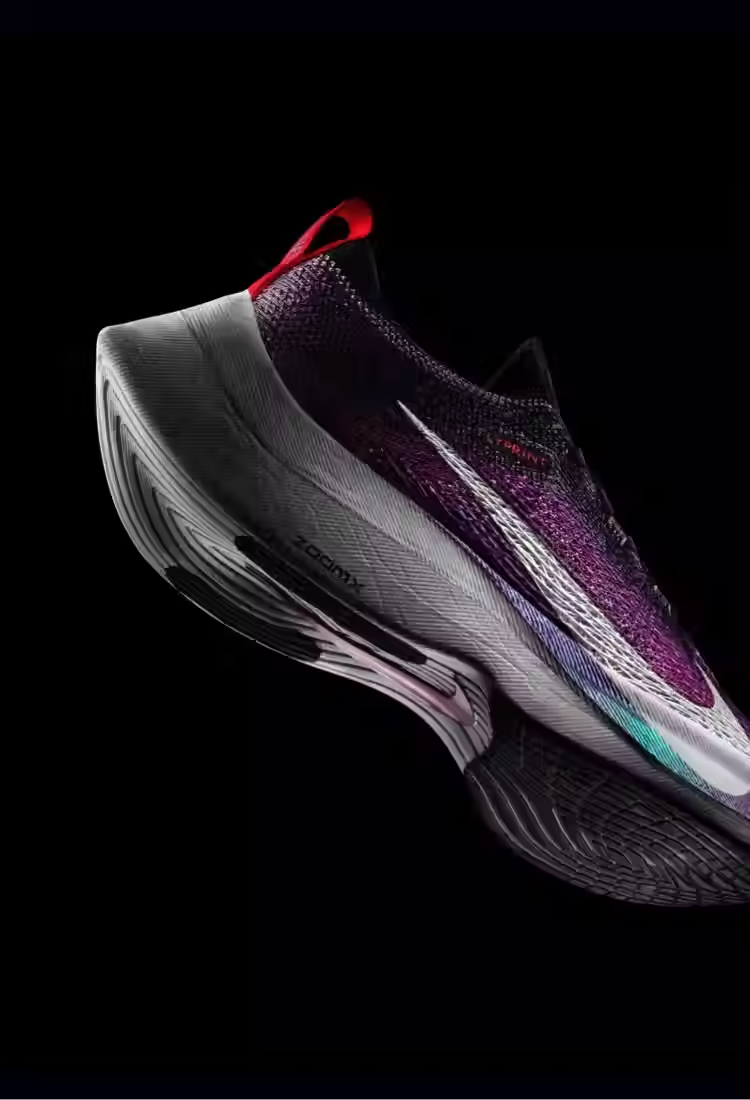
👟 Adidas & Footwear: AM Finds Its Niche
Adidas stole headlines with its Futurecraft 4D line - but AM hasn’t (yet) replaced injection molding for midsoles at scale.
So what happened?
Speed and cost remain barriers to true mass production.
However, AM has carved out a clear niche in:
Custom insoles
Tooling for new designs
Rapid prototyping for elite athlete gear
Adidas continues to release limited runs of 3D-printed footwear and collaborates with Carbon for lattice innovation - but the ambition of millions of AM midsoles remains out of reach for now.
Still, this is where digital thread matters - every prototype, tweak, and tooling element needs data. Authentise’s integration with design tools and MES systems makes it all seamless.
Why Some Scaled, and Some Stalled
The common thread? Success in AM production is increasingly tied to digital infrastructure - not just hardware. That’s where Authentise steps in.
The Takeaway
Yes, additive manufacturing is in production - but not everywhere, and not equally.
Airbus has doubled down. Bugatti still pushes the boundaries. Adidas has found its premium niche.
But across all of them, one thing is clear: AM production only works when data flows. Without digital transparency, traceability, and integration, even the most powerful machines can’t deliver at scale.
Ready to go from buzz to business?
Discover how Authentise Flows, our MES, and the Digital Design Warehouse can connect your AM workflow end-to-end - giving you the tools to scale safely, efficiently, and profitably.
👉 Book a Demo or explore our solutions at authentise.com


Comments